By: Tome Fierre
Choosing a career can feel overwhelming because there are thousands of possible jobs, endless opinions, and a lot of pressure to “figure it out.” Some people are just starting out. Others are changing careers, returning to work, feeling burned out, choosing a college major, or wondering whether they are on the wrong path entirely.
So the real question is not just, “What career assessment test should I take?”
The better question is:
What career assessment test actually works?
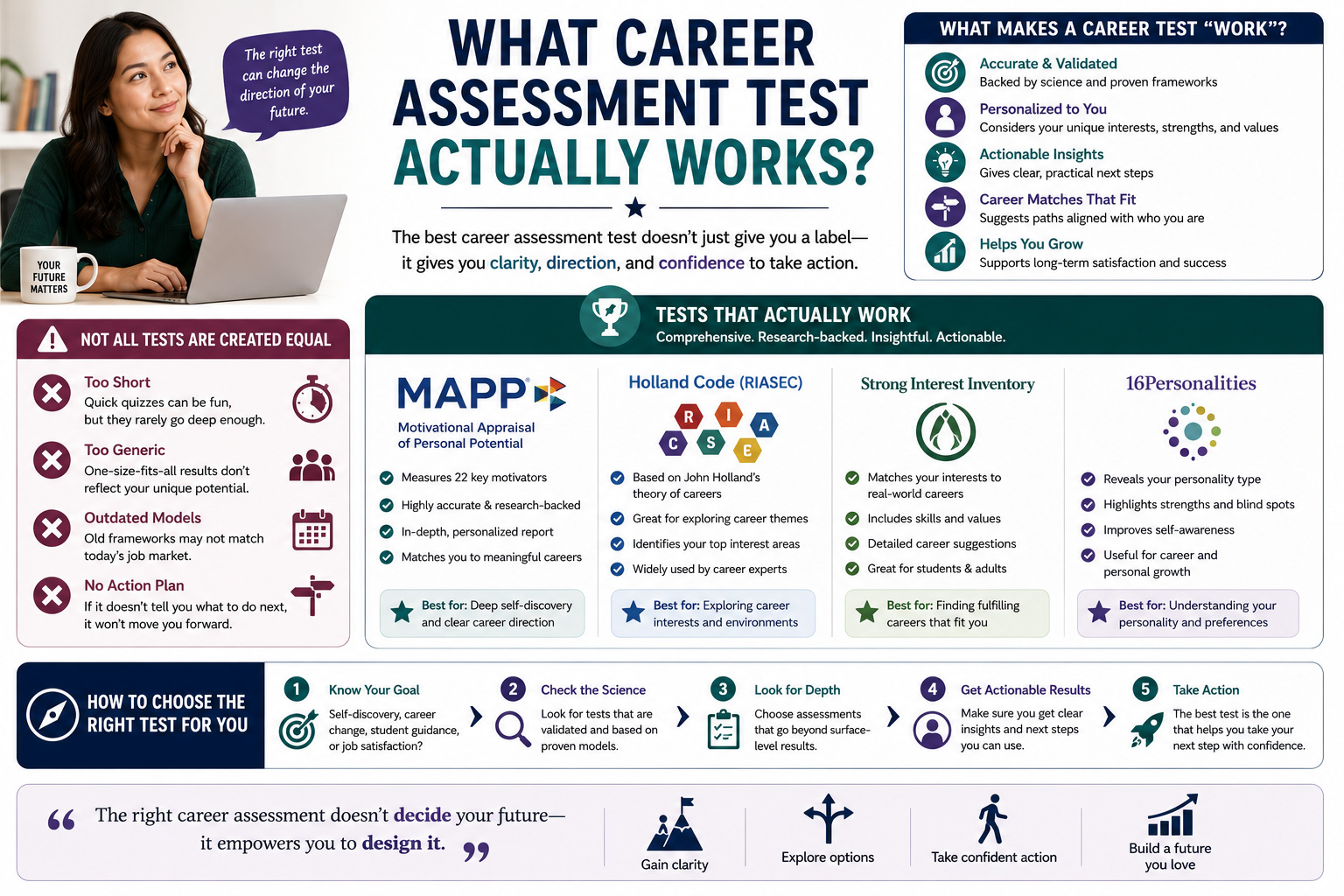
A career assessment works when it helps you understand yourself more clearly, connect your results to real career options, and take practical next steps. A test that gives you a fun label may be interesting. A test that helps you make better life and career decisions is far more valuable.
That is why the MAPP Career Assessment has helped millions of people around the world. MAPP is designed to identify your motivations, strengths, work preferences, and best-fit career paths. It does not just tell you what sounds interesting. It helps reveal what kind of work may actually fit the way you are wired.
At Assessment.com, users can take the worldwide-known MAPP Career Assessment and also explore the Assessment.com marketplace, which includes multiple career, personality, leadership, emotional intelligence, motivation, learning style, and personal growth assessments, many of them free.
If you are trying to stop guessing and start making better career decisions, a strong assessment can be one of the most useful places to begin.
What Makes a Career Assessment Actually Work?
A career assessment works when it gives you useful insight, not just a score.
The best career assessments usually do four things well.
First, they help you understand what motivates you. Many people choose careers based on salary, convenience, family expectations, or what they studied years ago. But long-term satisfaction often depends on whether the work fits your natural motivations.
Second, they connect your results to real careers. It is not enough to know you are creative, analytical, social, practical, independent, or organized. You need to know what career paths may match those patterns.
Third, they explain results in plain English. A career report should not feel like a psychology textbook. It should help you understand yourself quickly and clearly.
Fourth, they help you take action. Good results should point you toward next steps, such as careers to research, skills to build, majors to consider, jobs to explore, or questions to ask an AI career coach, counselor, or advisor.
This is where MAPP is powerful. It focuses on motivational fit and connects your profile to career options, so the results are practical, not just interesting.
10 Questions and Answers About Career Assessment Tests
- What career assessment test actually works?
A career assessment actually works when it helps you understand your motivations, strengths, work preferences, and career fit, then connects that insight to real career options. The MAPP Career Assessment is a strong choice because it focuses on what motivates you and matches your profile to careers that may fit.
- Are career assessment tests accurate?
A good assessment can be very helpful, but no test should make the decision for you. The best assessments act like a mirror. They help you see patterns, confirm what you may already feel, and uncover options you may not have considered.
- What is the difference between a career test and a personality test?
A personality test usually explains how you tend to think, communicate, and behave. A career assessment connects your traits, motivations, interests, and preferences to work. Personality insight is useful, but career matching is what helps turn insight into direction.
- Can a career assessment help if I already have a job?
Yes. Many adults use career assessments because they are already working but feel stuck, burned out, underused, or unsure what comes next. An assessment can help you decide whether you need a new job, a new role, a new company, a new industry, or simply a better-fitting path within your current field.
- Can a career assessment help with a career change?
Yes. Career changers often need clarity and confidence. A good assessment can help you identify what to carry forward from your past experience and what to leave behind. It can also help you explain your strengths in a new way.
- Are free career assessments worth taking?
Some free assessments can be useful, especially for self-reflection. However, more complete assessments usually provide deeper reporting, better career matching, and more actionable recommendations. The Assessment.com marketplace includes many free assessments, making it easy to explore different areas before or after taking MAPP.
- What should I look for in a career assessment?
Look for an assessment that is easy to understand, connects results to real careers, explains why careers fit, provides practical next steps, and helps you compare options. Avoid tests that only give you a label without useful guidance.
- Can a career assessment help with choosing a college major?
Yes. Career assessments can be very helpful for students and adults considering school. If you understand which careers fit you, it becomes easier to choose a major, certificate, training path, or degree that supports your direction.
- Can a career assessment help with burnout?
It can help identify whether burnout may be related to poor fit. Sometimes burnout comes from workload or environment. Other times, it comes from doing work that constantly goes against your natural motivations. An assessment can help separate those issues.
- What should I do after taking a career assessment?
Do not just read the report and stop. Review your top matches, look for patterns, research careers, compare options, update your resume language, talk to people in the field, and use the AI Career or College Coach on Assessment.com to ask questions about your results and next steps.
FAQ
- A career assessment works best when it explains what motivates you and connects that insight to real career options.
- MAPP is a strong career assessment because it focuses on motivational fit, not just personality labels.
- The best career tests are easy to understand and provide practical next steps.
- A good assessment should help you identify careers to explore, not force you into one answer.
- Career assessments are useful for students, adults, career changers, job seekers, and people feeling stuck.
- Free assessments can be helpful, and the Assessment.com marketplace includes many free career and personality tools.
- A personality test can help you understand yourself, but a career assessment should connect that self-understanding to work.
- Career assessments can help with college major selection, resume direction, interview preparation, and career pivots.
- The best results often confirm patterns you already suspected while revealing new options you had not considered.
- The most important step is using your results to create a plan, not just reading them once and moving on.
Why Some Career Tests Help and Others Do Not
Many career tests fail because they are too shallow.
They ask a few questions, give you a label, and then leave you wondering what to do next. You may learn that you are a “helper,” “thinker,” “leader,” “creator,” or “problem solver,” but that does not automatically tell you what careers to pursue.
A useful career assessment must go deeper.
It should help answer questions like:
What kind of work gives me energy?
What kind of work drains me?
Do I prefer people, data, ideas, things, systems, or service?
Do I want independence or structure?
Do I prefer variety or consistency?
Am I more motivated by helping, building, leading, analyzing, organizing, persuading, creating, or solving?
Which careers fit these patterns?
What should I research next?
This is important because many people are capable of doing work that does not actually fit them.
That is one of the biggest career traps.
You can be good at a job and still feel drained by it. You can earn a good income and still feel misaligned. You can be praised for work you do not want to keep doing. You can climb a ladder and later realize it was leaning against the wrong wall.
A strong assessment helps you see the difference between ability and fit.
Story: The Successful Professional Who Felt Trapped
Imagine a woman named Karen.
Karen has spent 12 years in project management. She is organized, dependable, and respected by her team. On paper, she is doing well. But she feels tired and disconnected.
At first, she thinks she needs a completely different career. After taking a career assessment, she sees a clearer pattern. She does not dislike project management itself. She dislikes managing deadlines and details without meaningful people development, strategy, or problem-solving.
Her results show that she is motivated by coaching, organizing, improving systems, and helping people succeed.
That changes everything.
Instead of asking, “Should I quit my career?” she asks, “How can I move toward training, leadership development, operations improvement, or team coaching?”
The assessment does not blow up her life. It gives her a smarter path forward.
Another Story: The Career Changer Who Needed a Bridge
Now imagine a man named Marcus.
Marcus has been in sales for 15 years. He is tired of quotas and pressure, but he is afraid that leaving sales means starting over. After taking a career assessment, he realizes the part of sales he enjoyed most was not closing. It was advising people, explaining options, solving problems, and building trust.
That insight helps him see new paths: customer success, consulting, recruiting, training, career advising, account management, or business development in a mission-driven field.
His past experience becomes a bridge, not a burden.
That is what a good career assessment can do. It can help you reframe your experience and see options that were hidden in plain sight.
Why MAPP Is Different
MAPP stands for Motivational Appraisal of Personal Potential.
The key word is motivational.
Many assessments focus mostly on personality. MAPP focuses on what motivates you in relation to work. That matters because motivation is often the difference between a career that looks good and a career that actually fits.
MAPP helps identify your preferred tasks, natural tendencies, work preferences, and best-fit career patterns. It can help you better understand why certain roles appeal to you, why some environments drain you, and which career paths may be worth exploring.
For adults, this is especially useful because career decisions are rarely simple. You may be balancing money, family, location, lifestyle, education, confidence, and fear of change. MAPP gives you a clearer starting point.
Why the Assessment.com Marketplace Matters
One assessment can give you powerful insight, but sometimes you need to understand yourself from more than one angle.
That is why Assessment.com includes an assessment marketplace with multiple career, personality, leadership, emotional intelligence, communication, motivation, learning style, team role, productivity, wellness, and personal growth assessments.
Many are free.
For example, someone might take MAPP to understand career direction, then take a personality assessment to understand communication style, a leadership assessment to prepare for management, and an emotional intelligence assessment to improve workplace relationships.
Together, these tools create a more complete picture.
Using the AI Career or College Coach
After you take an assessment, you may still have questions.
That is normal.
The AI Career or College Coach on Assessment.com can help you explore your results and turn them into next steps. You can ask questions like:
What do my results mean?
Which careers should I explore first?
Which careers should I avoid?
What college majors fit my profile?
What jobs should I search for?
How do I explain my strengths in an interview?
How can I pivot without starting over?
What skills should I build next?
That turns your assessment into an ongoing planning tool instead of a one-time report.
The Best Career Assessment Is the One You Actually Use
A career assessment only works if it helps you take action.
The best test is not the one with the most complicated report. It is the one that helps you understand yourself, compare options, and move forward with more confidence.
For some people, that means choosing a first career. For others, it means changing direction, finding a better role, choosing a college major, returning to work, preparing for AI-driven change, or finally understanding why a current path feels wrong.
If you are ready to stop guessing, start with the worldwide-known MAPP Career Assessment at Assessment.com. Then explore the Assessment.com marketplace for additional career and personality assessments, including many free tools.
Your future should not be built on pressure, guesswork, or outdated advice.
It should be built on self-understanding, better information, and a plan that fits who you really are.