Choosing a career is not as simple as picking a job title.
Yet many people take a career assessment hoping it will hand them one final answer. They want a result that says, “You should be a teacher,” “You should become a nurse,” “You belong in business,” or “You are this type of person.”
That kind of answer may feel helpful at first because it creates a sense of certainty. But in reality, careers are more complex than that. People are more complex than that too.
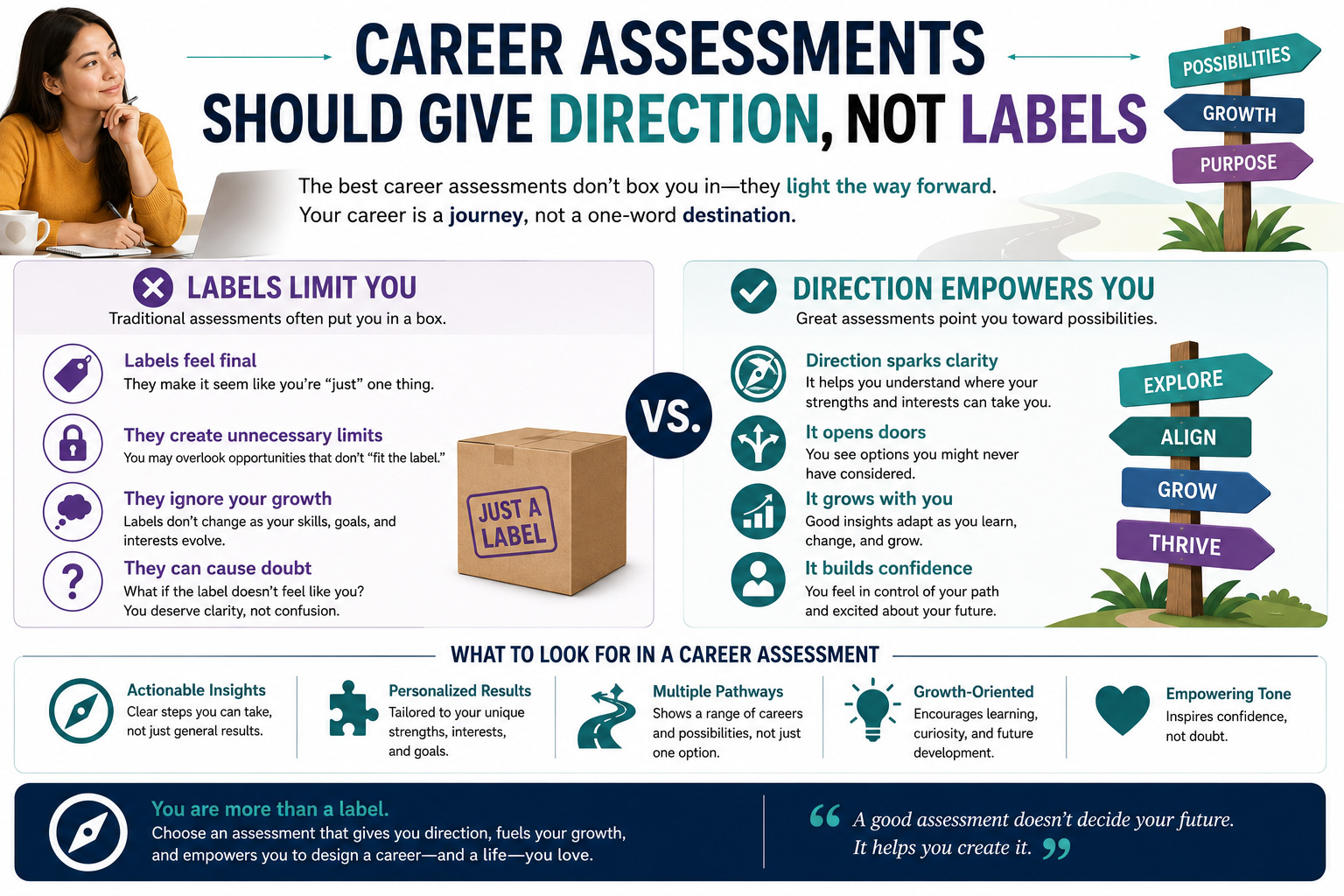
The best career assessments should not box you into one label. They should help you understand yourself more clearly, explore possible directions, compare options, and make better decisions.
A strong career assessment should work more like a compass than a cage.
It should help you see where you may want to go, not pretend to decide your entire future for you.
Why Career Labels Can Be Limiting
A label is easy to understand. That is why people like them.
If an assessment says you are a “helper,” “leader,” “creator,” “analyst,” “builder,” or “communicator,” that can give you useful language. It may help you recognize patterns in how you think, work, and make decisions.
But labels can also become limiting when they are treated as final answers.
A person is rarely just one thing. Someone may enjoy helping others, but also like strategy, writing, technology, and problem-solving. Another person may enjoy data and analysis, but also want creativity, autonomy, and human connection. A student may be interested in healthcare, but that does not mean every healthcare career is equally right for them.
When a career assessment gives only a label, it can narrow a person’s thinking too quickly.
Instead of asking, “What possibilities does this open for me?” the person may think, “This is what I am supposed to be.”
That is the wrong way to use career assessment results.
A better assessment should help you see patterns and possibilities, not force you into one box.
One Career Answer Is Usually Not Enough
Career decisions involve many factors.
A career may look good on paper but still be a poor fit in daily life. Another career may seem unfamiliar at first but may actually align well with your motivations, strengths, and preferred work style.
When choosing a career direction, people should consider:
- What motivates them
- What kinds of tasks they enjoy
- What skills they have or want to build
- What education or training may be required
- What work environments fit them best
- What salary range they need or want
- What lifestyle they are trying to create
- What job opportunities exist
- What tradeoffs they are willing to make
- What kind of work they can see themselves doing over time
No single assessment can make all of those decisions for someone.
A career assessment can provide valuable insight, but it should not be treated as the only input. The goal is not to let a test choose your future. The goal is to use better information to make a better decision.
Direction Is More Valuable Than Prediction
Some career tools try to sound overly certain. They suggest that if you answer a set of questions, they can predict exactly what you should do.
That is not how real career planning works.
The most helpful assessments provide direction. They help you understand where to look, what to compare, and what questions to ask next.
A direction-based assessment may help you discover:
- Career areas that fit your motivations
- Job types that align with your strengths
- Work environments that may support you
- Tasks that may energize you
- Responsibilities that may drain you
- Education paths worth exploring
- Jobs that may deserve deeper research
- Related careers you may not have considered
That kind of guidance is more honest and more useful than a single prediction.
A career assessment should help you say, “These paths may be worth exploring,” not, “This test has decided who I am.”
A Good Career Assessment Starts a Better Conversation
One of the most valuable things a career assessment can do is create a better conversation.
A student can use assessment results to talk with a parent, counselor, or advisor about majors and career paths.
A career changer can use results to talk with a coach about what has been missing from their current work and what kinds of roles may fit better.
A job seeker can use results to evaluate job descriptions more carefully and prepare stronger interview questions.
A manager can use assessment insight to better understand what may motivate an employee and where that person may be best positioned to contribute.
Good assessments do not end the conversation.
They improve it.
They give people better language, better questions, and a better starting point for decision-making.
The Best Assessments Show Fit and Tradeoffs
A useful career assessment should not only show what may fit. It should also help you understand the tradeoffs.
A career can be appealing in one way and challenging in another.
For example:
- A career may fit your interests but require years of education.
- A job may offer strong income but involve tasks you do not enjoy.
- A role may use your skills but not match your preferred work environment.
- A field may be exciting but have limited openings in your location.
- A path may align with your motivation but require a lifestyle you do not want.
This is why career exploration should include both fit and reality.
A strong assessment should help users ask:
- What parts of this career may I enjoy?
- What parts may I dislike?
- What education or training is required?
- What is the earning potential?
- What does a typical day look like?
- What work environment is common?
- What are the related careers?
- What are the risks and opportunities?
- What would I need to learn before pursuing this path?
The goal is not just to find careers that sound interesting. The goal is to understand whether a path makes sense for your motivations, goals, and life.
Motivation Matters More Than Many People Realize
Skills matter. Interests matter. Experience matters. Personality matters.
But motivation may be one of the most important parts of career fit.
Why?
Because motivation influences what people are willing to keep doing.
A person may be capable of performing a job, but if the work consistently drains them, they may struggle to stay engaged. Another person may begin with less experience, but if the work fits their natural motivations, they may be more likely to learn, practice, improve, and persist.
Motivation helps answer questions such as:
- What kind of work gives me energy?
- What tasks do I naturally want to do?
- What responsibilities feel meaningful to me?
- What kinds of work may frustrate me over time?
- Where am I most likely to develop skill because I care about the work?
- What work could I see myself doing repeatedly without losing interest?
This is why motivation-based career assessments can be especially helpful. They look beyond surface-level job titles and explore the deeper patterns behind career satisfaction.
The MAPP™ Career Assessment as a Strong Example
One strong example of a direction-based career assessment is the MAPP™ Career Assessment, available through Assessment.com.
MAPP™ stands for Motivational Appraisal of Personal Potential, and its focus on motivation is one of the reasons it can be useful for career exploration.
Rather than simply assigning a person one narrow label, the MAPP™ assessment helps users understand patterns in how they may prefer to work. It looks at areas such as interests, temperament, aptitude, people, things, data, reasoning, math, language, and other work-related preferences.
That matters because career fit is rarely about one factor.
A person may be drawn to communication but not enjoy constant persuasion. Another may like analysis but not want a highly isolated work environment. Another may enjoy helping others but prefer coaching, advising, training, or healthcare support rather than traditional classroom teaching.
A good assessment helps reveal those distinctions.
The MAPP™ Career Assessment is a useful example of doing this well because it can help users explore multiple career directions, understand why certain paths may fit, and compare options rather than relying on a single label.
When paired with modern career tools, users can also explore detailed career information, education pathways, job possibilities, and AI-supported career guidance.
That is how assessments should be used: as decision-support tools, not as label makers.
No Assessment Should Make the Decision for You
No single career assessment should decide your career.
Not a personality test.
Not an interest inventory.
Not an aptitude test.
Not a motivation-based assessment.
Not an AI career tool.
Not even a highly detailed report.
Assessments can provide insight, but they should not replace judgment.
The best career decisions usually combine assessment results with:
- Career research
- Real job descriptions
- Salary and labor market data
- Education and training requirements
- Conversations with people in the field
- Coaching or advising
- Work experience
- Internships or projects
- Personal values
- Family and lifestyle considerations
- Financial goals
- Trial and reflection
Assessment results should help you make a better decision, not make the decision for you.
A good assessment gives you direction. You still choose the path.
Why This Matters for Students
Students are often asked to make major career and education decisions before they have enough experience to fully understand their options.
They may be asked to choose a major, consider a college, select a program, or think about a future career while still learning who they are.
Without good guidance, students may choose based on:
- What their friends are doing
- What their parents suggest
- What sounds prestigious
- What seems practical
- What they have seen online
- What they think will make money
- What they believe they are “supposed” to do
A career assessment can help students slow down and explore more thoughtfully.
Instead of asking, “What should I be?” students can ask:
- What kinds of work fit how I am motivated?
- What careers should I research?
- What majors connect to those directions?
- What would I likely enjoy doing every day?
- What careers should I compare before deciding?
- What paths may not fit me as well?
- What questions should I ask a counselor or advisor?
For students, a good assessment should open possibilities and support better education planning.
It should not lock them into one answer too early.
Why This Matters for Career Changers
Career changers often know something is not working, but they may not know what should come next.
They may feel burned out, bored, underused, overwhelmed, or disconnected from their work. But without clearer direction, changing careers can feel risky and confusing.
A career assessment can help identify what may be missing.
For example, a person may discover that their current work involves too much routine and not enough variety. Another may realize they want more people interaction. Another may see that they enjoy problem-solving but dislike constant sales pressure. Another may discover that they are motivated by communication, mentoring, and advising but rarely get to use those strengths.
These insights can help career changers explore better-fit options.
The goal is not to say, “Your new career label is this.”
The goal is to help the person understand which directions may be worth exploring and what tradeoffs they should consider before making a move.
Why This Matters for Job Seekers
Job seekers often search by job title, company, salary, and location.
Those things matter. But they do not always reveal whether a job will be a good fit.
A job can look attractive in a posting but still involve daily work that does not match a person’s motivations or preferred work style.
A career assessment can help job seekers evaluate opportunities more carefully.
Instead of only asking, “Can I get this job?” they can also ask:
- Would I likely enjoy this kind of work?
- Does this role fit my motivations?
- Which parts of the job description appeal to me?
- Which responsibilities concern me?
- Is this role connected to one of my stronger career directions?
- What should I ask in the interview to understand fit?
- Is this job a step toward a better long-term path?
This can make the job search more intentional.
The goal is not just to get a job. The goal is to find work that has a better chance of fitting.
Why This Matters for Coaches, Schools, and Employers
Career assessments are not only useful for individuals. They can also help professionals and organizations support better decisions.
Career coaches can use assessment results to guide clients through exploration, comparison, and planning.
Schools can use assessments to support advising, major selection, career readiness, and student retention.
Workforce programs can use assessments to help participants choose training paths and job directions that are more likely to fit.
Employers can use assessment insights to support role fit, development, internal mobility, coaching, retention, and hiring conversations when used responsibly.
In each setting, the assessment should not be treated as the final answer.
It should be the beginning of a better conversation.
Good Assessments Create Curiosity
One sign of a strong career assessment is that it makes the user more curious.
A good result should make someone want to learn more, not stop thinking.
It should encourage users to explore related careers, compare options, research job descriptions, look at education pathways, ask better questions, and think more deeply about what they want their work life to look like.
If an assessment result makes a person feel boxed in, discouraged, or overly defined by a label, something is wrong with how the assessment is designed, explained, or used.
A strong assessment creates both clarity and curiosity.
That combination helps people move forward with more confidence.
A Better Way to Read Career Assessment Results
Instead of asking, “What did the assessment say I am?” ask better questions.
Ask:
- What patterns do I see?
- What directions keep showing up?
- Which results feel accurate?
- Which results surprise me?
- What careers should I research?
- What tradeoffs should I consider?
- What paths should I compare?
- What do I want to test in the real world?
- Who should I talk to about these options?
- What is my next best step?
This turns the assessment into a tool.
That is exactly what it should be.
Careers are built over time. People change. Industries change. Skills develop. Priorities shift. Opportunities appear.
A good assessment helps you make a better next decision. It should not pretend to answer every question forever.
Career Assessments Should Be Compasses
The best metaphor for a career assessment is a compass.
A compass does not decide the destination. It does not walk the road. It does not guarantee that the path will be easy.
But it helps you orient yourself.
It helps you understand direction.
It helps you move with more confidence.
That is what career assessments should do.
They should help people move from confusion to clarity, from guessing to guided exploration, and from limiting labels to meaningful possibilities.
The MAPP™ Career Assessment is a strong example of this philosophy when used correctly because it emphasizes motivation, career direction, detailed fit, and exploration across many possible paths.
But the broader principle applies to all career assessments:
The purpose of an assessment should not be to define you.
The purpose should be to help you understand yourself well enough to make better decisions.
Final Thought: Your Career Should Not Be Chosen by a Label
Career assessments are most powerful when they expand possibilities instead of narrowing them too soon.
They should help people understand their motivations, strengths, preferences, and options. They should help users compare career directions, evaluate tradeoffs, and ask better questions.
They can support students choosing majors, adults changing careers, job seekers evaluating roles, coaches guiding clients, schools advising students, workforce programs helping participants, and employers supporting development.
But they should not assign a person a permanent label.
No assessment should choose your future for you.
The right assessment should help you see your future more clearly, so you can choose it with greater confidence.