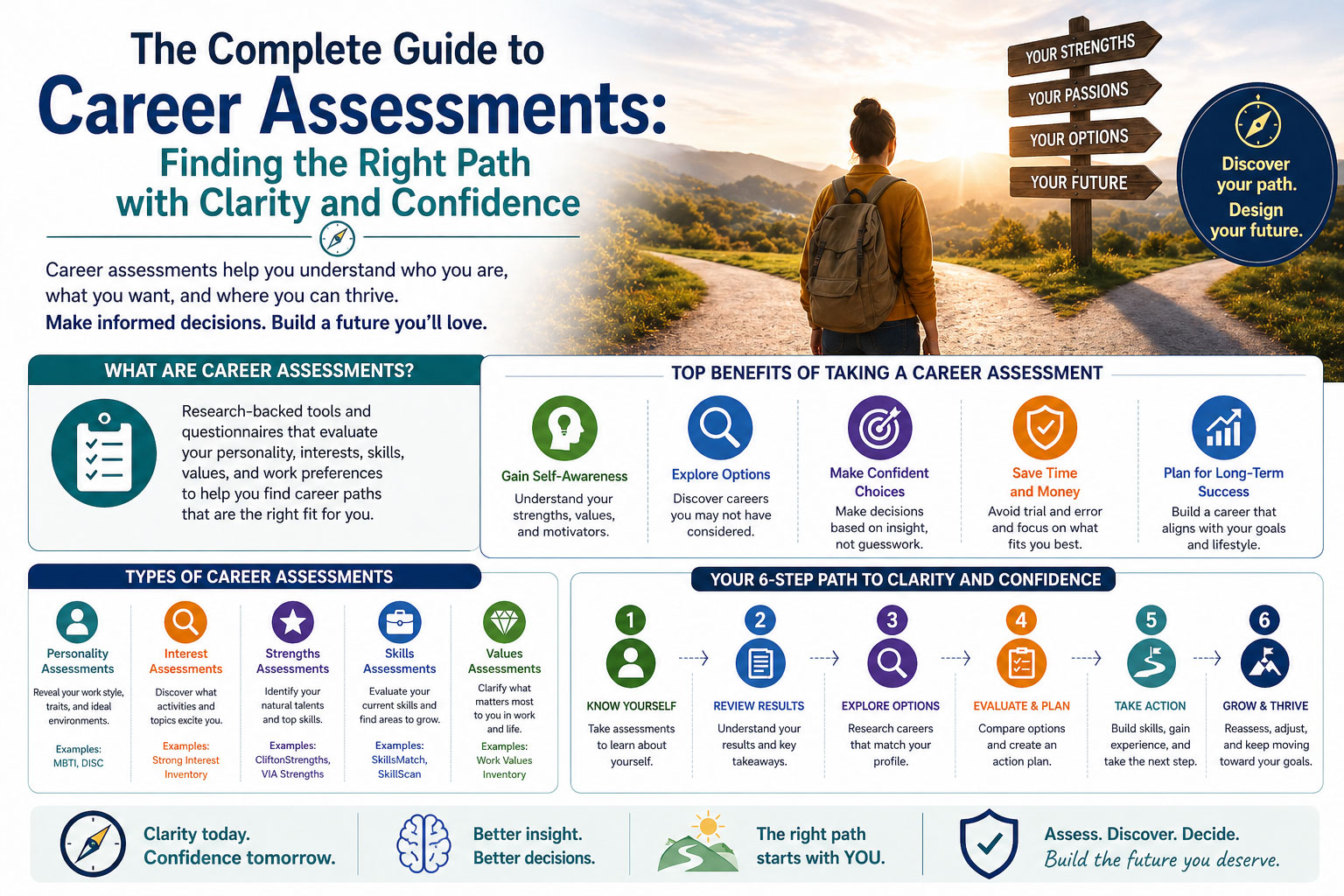
The Complete Guide to Career Assessments: Finding the Right Path with Clarity and Confidence
Choosing a career or deciding when it’s time to change one—is one of the most important decisions a person will ever make. Yet, most people make these choices based on limited information, outside expectations, or outdated assumptions.
That’s where career assessments become incredibly valuable.
When used correctly, career assessments provide structured, data-driven insights into how you think, what motivates you, what you’re naturally drawn to, and where you’re most likely to thrive—not just perform.
This guide will walk you through:
- The different types of career assessments
- What each type actually measures
- How to use them effectively
- Common mistakes to avoid
- And how modern platforms are transforming the entire assessment experience
What Are Career Assessments?
Career assessments are tools designed to help individuals better understand key aspects of themselves, including:
- Strengths and abilities
- Personality traits and tendencies
- Motivations and interests
- Preferred environments and work styles
The ultimate goal is simple:
Match individuals to roles, careers, and environments where they are most likely to succeed and feel fulfilled.
However, not all assessments are created equal. Some focus on ability. Others focus on personality. The most powerful ones go deeper—into motivation, which is often the missing link in long-term career satisfaction.
Why Career Assessments Matter More Today
The career landscape has changed dramatically:
- Career paths are no longer linear
- People change jobs—and industries—multiple times
- Entire roles are being reshaped by technology
In this environment, alignment becomes critical.
Without alignment, people often experience:
- Burnout
- Low engagement
- Underperformance
- Constant career uncertainty
With alignment, the opposite happens:
- Energy increases
- Growth accelerates
- Satisfaction improves
- Long-term success becomes sustainable
The Core Types of Career Assessments
To truly understand yourself, you need to look across multiple dimensions—not just one.
- Motivation-Based Assessments (The Foundation)
What They Measure:
- What drives you
- What energizes vs. drains you
- The types of work you naturally enjoy
Why It Matters:
You may be capable of doing many things—but you’ll only thrive in roles aligned with your motivation.
A leading example is the MAPP® Assessment (Motivational Appraisal of Personal Potential), which has helped millions identify where they are most likely to excel over time.
👉 Key insight:
Ability shows what you can do. Motivation determines what you will sustain and excel at long term.
- Personality Assessments
What They Measure:
- Behavioral tendencies
- Communication style
- How you interact with others
Common Models:
Why It Matters:
Personality plays a major role in:
- Team dynamics
- Leadership style
- Workplace communication
However, personality alone doesn’t determine career fit—it needs to be combined with motivation and interests.
- Interest-Based Assessments
What They Measure:
- Activities and subjects you enjoy
- Areas of curiosity and exploration
Examples:
Example: College Major & Degree-Path Alignment Assessment (Prospective or New College Students)
Why It Matters:
Interests are especially useful for:
- Students
- Early career exploration
But interests evolved so they should guide direction, not define it permanently.
- Skills & Aptitude Assessments
What They Measure:
Why It Matters:
These assessments answer a key question:
“Can you do the job?”
They are widely used in:
- Hiring processes
- Academic placement
- Technical career paths
- Behavioral & Work Style Assessments
What They Measure:
Examples:
Why It Matters:
These insights are critical for:
- Team effectiveness
- Leadership development
- Organizational alignment
- Values-Based Assessments
What They Measure:
- What matters most to you
- Your sense of purpose
- Lifestyle and impact preferences
Why It Matters:
Even high-performing individuals become dissatisfied when their work doesn’t align with their values.
The Most Common Mistake
The biggest mistake people make is relying on just one type of assessment.
For example:
- Personality alone → incomplete
- Interests alone → short-term
- Skills alone → ignores fulfillment
The best results come from combining:
- Motivation
- Personality
- Interests
- Skills
- Values
This creates a complete picture of career fit.
How to Use Career Assessments Effectively
Assessments don’t give you answers—they give you insight.
Here’s how to use them properly:
- Focus on Patterns
Don’t fixate on a single result.
Instead:
- Look for consistent themes
- Identify repeating strengths and preferences
- Pair Insight with Reflection
Ask yourself:
- Does this resonate?
- Where have I experienced this before?
- Take Action
Insight without action leads nowhere.
- Try new roles
- Explore projects
- Experiment
- Revisit Regularly
You evolve over time.
What worked years ago may no longer fit today.
The Role of AI in Modern Assessments
Traditional assessments were static:
Take test → Read report → Done
Today, AI changes the experience entirely.
What AI Enables:
- Real-time interaction with results
- Personalized explanations
- Dynamic career recommendations
- Ongoing guidance and coaching
Instead of reading a report…
You can now engage with your results as a conversation.
The Shift to Assessment Platforms
The future isn’t just individual tests—it’s integrated platforms.
Modern platforms combine:
- Multiple assessment types
- AI-powered insights
- Career matching tools
- Custom assessment creation
- Marketplace access
The New Assessment.com Platform
A leading example of this evolution is Assessment.com—a platform designed to bring everything together in one place.
🛒 Assessment Marketplace (Nearly 100 Assessments)
- Access a growing library of nearly 100 assessments
- Covering career, personality, skills, leadership, and more
- A majority are free to use
This allows you to:
- Explore different dimensions
- Compare results
- Build a more complete understanding of yourself
🤖 AI Assistant
- Interact with your results
- Ask career-related questions
- Generate insights and action plans
🛠️ Assessment Builder (Manual + AI)
- Create custom assessments
- Tailor them to specific audiences
- Use AI to generate questions, scoring, and reports
💼 Build, Host, and Monetize
- Host assessments privately for clients or organizations
- Or publish them globally in the marketplace
- Monetize your expertise at scale
Who Benefits from Career Assessments?
Individuals
- Career clarity
- Career transitions
- Personal growth
Students
- Choosing majors
- Exploring career paths
Businesses
- Hiring decisions
- Talent development
- Role alignment
Coaches & Consultants
- Deeper client insights
- Scalable services
- Structured guidance
When to Use Career Assessments
Ideal moments include:
- Entering the workforce
- Considering a career change
- Feeling stuck or disengaged
- Preparing for leadership roles
- Planning education or degree paths
Final Thought: It’s About Alignment
Career assessments don’t give you a job.
They give you clarity.
And clarity leads to better decisions.
The real question isn’t:
“What should I do?”
It’s:
“Where will I thrive?”
When you align:
- Motivation
- Strengths
- Personality
- Values
Everything changes.
Start Exploring
If you’re serious about making better career decisions, don’t rely on just one assessment.
Explore multiple perspectives. Use modern tools. Build a complete picture.
We’re excited to introduce the new Assessment.com platform—a powerful evolution that brings together the globally trusted MAPP® assessment, an AI-powered assistant for real-time insights, and a growing Assessment Marketplace featuring nearly 100 assessments (many free). The platform also allows you to build, host, and monetize your own assessments—either privately or globally—making it easier than ever to turn insight into action.
Get started with free access today and explore everything the platform has to offer:
https://www.assessment.com
And take advantage of platforms like Assessment.com, where you can access a wide range of assessments—over 50 for free—and begin building a clearer, more confident path forward.